
I came to Wick is Pain the way I come to most action films: with a controller in my lap and a stopwatch in my head. I had replayed the John Wick movies so often that the gun-fu beats felt like speedrun splits, and I assumed a making-of documentary would be a pleasant victory lap. I was wrong in the best way. Wick is Pain, produced by franchise director Chad Stahelski and star Keanu Reeves, is not a glossy promo reel. It is a decade of never-before-seen on-set and off-set footage stitched into a story about how one scrappy revenge thriller became a multimedia empire. Watching it in 2026, after the franchise has pushed further into spinoff territory, feels like opening a saved game and finally seeing the path that unlocked the map.

The first thing that struck me was the key art. The poster highlights Reeves as the titular action antihero, looking beat up in exactly the way Wick looks after taking down a few dozen mercenaries and gangsters. It is a smart visual thesis: this is not the polished assassin of a power fantasy, but the bruised worker at the center of an impossible job. The documentary arrived on digital platforms on May 9, 2025, and by the time I revisited it in 2026 it had become something more than a release-week curiosity. It is a record of how the franchise’s signature stunt work was built, and how a single film grew into a world of characters and settings.
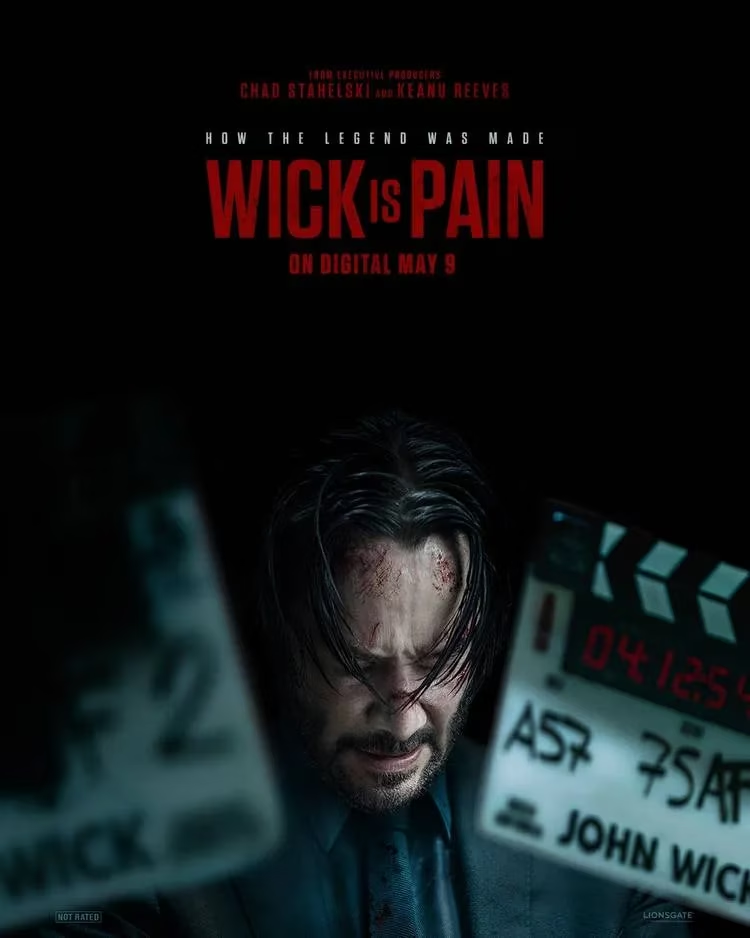
I went in expecting a highlight reel of headshots. What I got was closer to a production diary with bruises. The documentary digs into the first John Wick movie’s hurdles, from budget woes to creative challenges, and shows what Stahelski, Reeves, and the rest of the team went through to make the film that launched an empire. That origin-story pressure matters. A lot of action franchises pretend they were inevitable; Wick is Pain treats the first film like a raid boss that could have wiped the party. The documentary is like a locksmith walking me through a vault after I have already watched someone blow the door off. I knew the finished heist; now I understood the tumblers.
What I appreciated most was the focus on physical craft. The franchise earned a making-of documentary thanks to the strength of its action sequences alone. From the number of stunts Reeves performed himself to the explosive performances of actors like Donnie Yen and Hiroyuki Sanada, the fight scenes are full of feats that would be thrilling even outside the movie’s story. In Wick is Pain, those feats get context: the repetition, the timing, the near-misses, and the choreography that turns violence into something closer to dance notation. As someone who treats action choreography like a speedrun route, I found that deeply satisfying. The film is a backstage pass stitched from scar tissue.
| What I expected | What Wick is Pain delivers |
|---|---|
| A glossy victory lap | A roots-level account of the first film’s budget and creative struggles |
| A simple stunt showcase | A decade of on-set and off-set footage that explains the craft |
| A franchise advertisement | A bridge from one movie to a growing multimedia empire |
By 2026, the franchise’s growth is impossible to ignore. The world Stahelski built keeps expanding, and the first spinoff, Ballerina, has carried Ana de Armas into the same neon-lit underworld. Reeves’ status as Wick remains slightly uncertain, and the franchise at large now includes more characters and settings than the original film could have promised. That is exactly why Wick is Pain still works. It turns the focus back on the roots while the roots are still visible. Watching the franchise grow is like finding a coral reef that was assembled by hand, one bruise at a time. The documentary does not pretend the reef appeared overnight; it shows the divers, the plans, and the accidents.
I also like where Wick is Pain sits in the release timeline. It hit digital platforms on May 9, 2025, and all four John Wick movies were available to stream in one place for a refresher. In 2026, that makes the documentary feel like a save point before the next expansion. It is not just a bonus feature for completionists. It is a map of the franchise’s inflection point, made by the people who were in the room when the first film’s future was anything but certain. I finished it with the same feeling I get after a perfect no-hit run: impressed by the execution, but more interested in the invisible work that made it look easy. Wick is Pain is that invisible work, finally put on screen.
Comments