
It's 2026, and as a longtime follower of the Marvel Cinematic Universe, I've watched heroes rise, fall, and pass their torches countless times over the last two decades. But rarely has a new mantle felt as raw, personal, and perfectly timed as the one quietly building in Hell's Kitchen. With Daredevil: Born Again season 2 poised to expand its street-level canvas, the emergence of Angela del Toro as the new White Tiger is not just another legacy story — it’s shaping up to be the most emotionally grounded superhero succession the MCU has ever attempted.
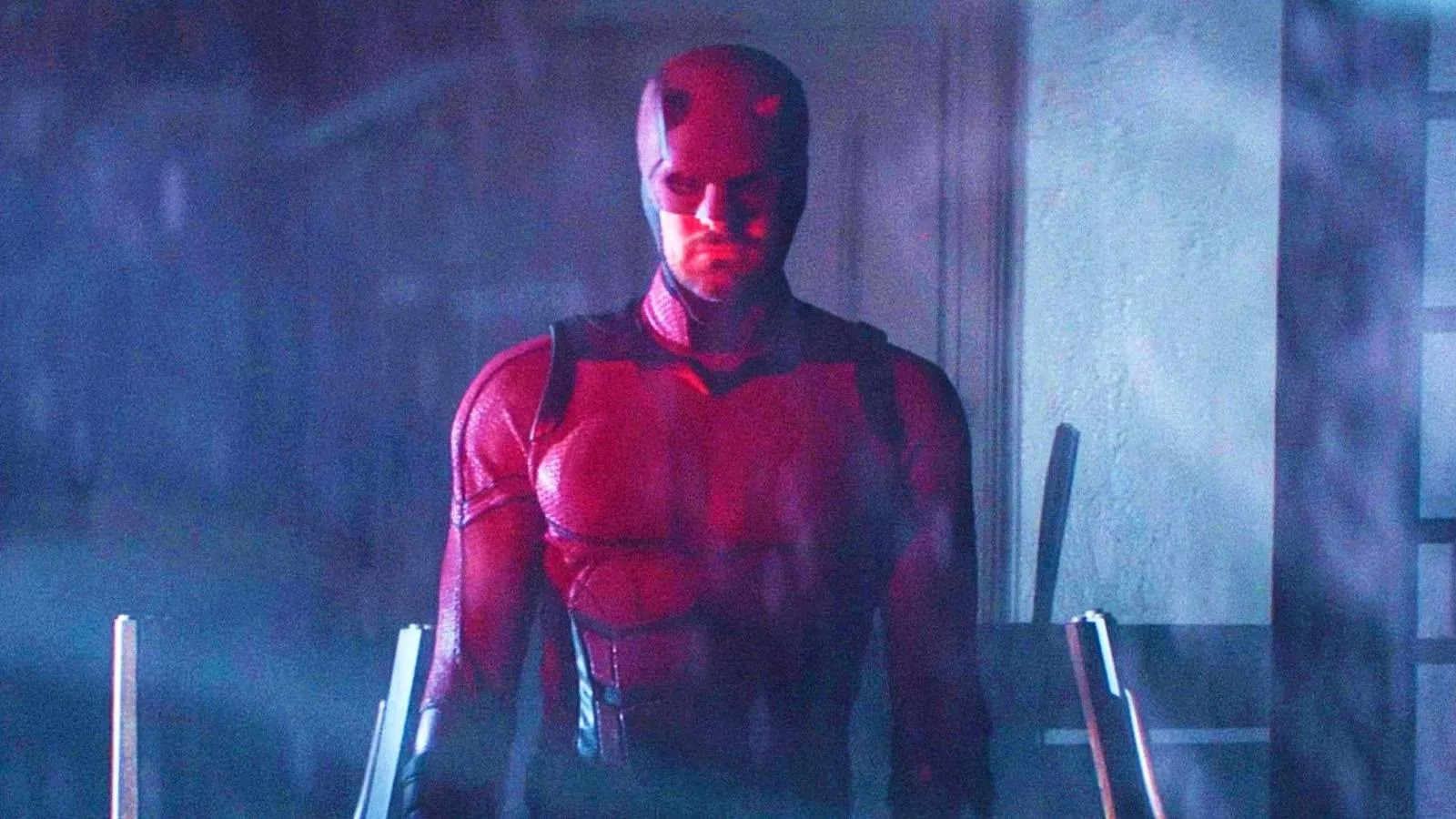
The first season of Daredevil: Born Again took bold creative swings, not least by retroactively weaving the Netflix-era Defenders saga into the Sacred Timeline. But its most heartbreaking moment came when Hector Ayala, the original White Tiger, was gunned down by a corrupt police officer on a rain-soaked street. That brutal act didn't just kill a hero — it planted a seed of vengeance and duty in his niece, Angela. According to set photos first reported by The Direct, she\u2019s been seen wearing a homemade White Tiger costume, signaling her transformation from grieving relative to full-fledged vigilante. And because this is unfolding in the grounded, morally complex world of Daredevil, the setup promises something the MCU\u2019s larger-than-life Avengers handoffs can\u2019t easily offer: a slow, flawed, deeply human mentorship arc carved from tragedy.
Marvel Studios has, of course, mastered the art of the passing of the shield \u2014 literally. Sam Wilson\u2019s journey to becoming Captain America and Kate Bishop\u2019s tutelage under Clint Barton\u2019s Hawkeye demonstrated that audiences embrace new faces when the emotional scaffolding is solid. Even smaller transitions, like Yelena Belova stepping into Natasha Romanoff\u2019s shadow, or Shuri ascending as Black Panther, proved that the comic book tradition of mantle-swapping translates powerfully on screen. Yet Angela del Toro’s White Tiger occupies a distinctive niche. She isn\u2019t training to join a global initiative or defend the quantum realm from multiversal threats. She\u2019s learning to protect a handful of blocks in Hell\u2019s Kitchen, where the consequences of failure are measured not in cataclysmic destruction but in personal loss — a corner store robbed, a witness intimidated, a family shattered. This street-level scope strips away the plot armor that often cushions god-tier heroes and forces Angela to grow in the unforgiving shadow of her uncle\u2019s murder.
What makes this particular succession feel so fresh is also the format. Ongoing television, as opposed to two-hour films, allows for incremental evolution. We saw glimpses of this potential in the Netflix Defenders universe, where characters like Jessica Jones and Luke Cage wrestled with their identities over multiple episodes. Now, with Daredevil: Born Again\u2019s longform storytelling, Angela can stumble, misjudge a threat, or fail to save someone — and then learn from those scars. That\u2019s a route the MCU\u2019s cinematic legacy heroes have rarely been afforded. Kate Bishop nailed her first team-up with Hawkeye by the season finale; Sam Wilson essentially became Captain America in one climactic speech. Angela, by contrast, could spend an entire season just mastering the emotional weight of the amulet before she ever feels worthy of calling herself White Tiger. Throw in Matt Murdock\u2019s own hard-won experience as a mentor, and you have a recipe for a partnership that deepens both characters.
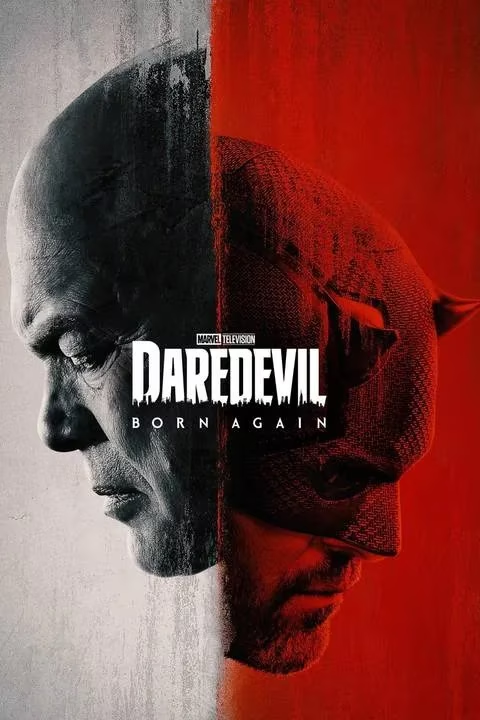
And then there\u2019s the revenge angle. Unlike many mantle-passings where the predecessor dies an off-screen or generic death, Hector Ayala\u2019s murder was a visceral, on-camera injustice directly tied to the police corruption that Mayor Wilson Fisk has weaponized. Angela\u2019s pursuit of the people responsible propels her story into a moral gray zone that echoes Matt\u2019s own struggles between the law and vigilantism. It\u2019s personal, messy, and dripping with dramatic tension. She won\u2019t just be honoring a symbol; she\u2019ll be chasing closure, and that\u2019s a motivation that can sustain years of narrative.
Looking ahead through the 2026 lens, Marvel\u2019s Phase Six is bustling with multiversal epics like Secret Wars, but the studio\u2019s decision to keep investing in a grounded, street-level saga feels like a corrective to the spectacle fatigue some fans have voiced. The White Tiger\u2019s emergence alongside Daredevil, potentially reuniting with other Defenders like Jessica Jones or Luke Cage, signals a renewed commitment to intimate heroism. Angela\u2019s homemade suit — as reported from those set leaks — is a far cry from stark-tech armor or mystic enchantments. It\u2019s a poignant visual reminder that heroes are born from need, not from billion-dollar budgets. In a franchise that often ties legacy to billion-dollar box office returns, showing a young woman stitching together her uncle\u2019s broken mythos in a Hell\u2019s Kitchen apartment is refreshingly small-scale.
Of course, Marvel has fumbled succession stories before. Some characters have felt rushed or overshadowed by their predecessors\u2019 looming presence. But the deliberate pacing hinted at for Daredevil: Born Again season 2 \u2014 with showrunner Chris Ord and the writing team weaving Angela\u2019s origin through the fabric of Matt\u2019s own battle against Fisk \u2014 suggests they understand what makes a transition resonate. It\u2019s not about the costume, the powers, or even the name. It\u2019s about why someone chooses to wear it when doing so only guarantees more pain. Hector Ayala learned that lesson with his life. Angela del Toro is about to learn it on the job.
From where I\u2019m sitting in 2026, looking back at the MCU\u2019s ever-growing tapestry, the White Tiger\u2019s journey stands as a quiet but powerful testament to what superhero storytelling can achieve when it strips away the cosmic noise and remembers that grief is a far stronger motivator than any infinity stone. She may not be an Avenger. She may never leave the grimy alleys of Hell\u2019s Kitchen. But if her arc unfolds with the emotional honesty that Daredevil: Born Again has proven it can deliver, Angela del Toro will become a hero whose legacy matters not because she inherits power, but because she earns it in the most human way possible.
Comments