
When Mission: Impossible – The Final Reckoning arrived on May 23, 2025, it did more than deliver another globe-trotting stunt show. In 2026, it still feels like the franchise’s connective tissue, a 170-minute action-adventure-thriller directed by Christopher McQuarrie and produced by Tom Cruise. Picking up two months after Mission: Impossible – Dead Reckoning, the film keeps much of the same cast, including Tom Cruise as Ethan Hunt and Hayley Atwell as Grace, while adding a surprising returning player and tying its villainous threat back to two earlier installments. The result is a movie that treats the first and third Mission: Impossible films as essential chapters rather than forgotten lore. 🎬
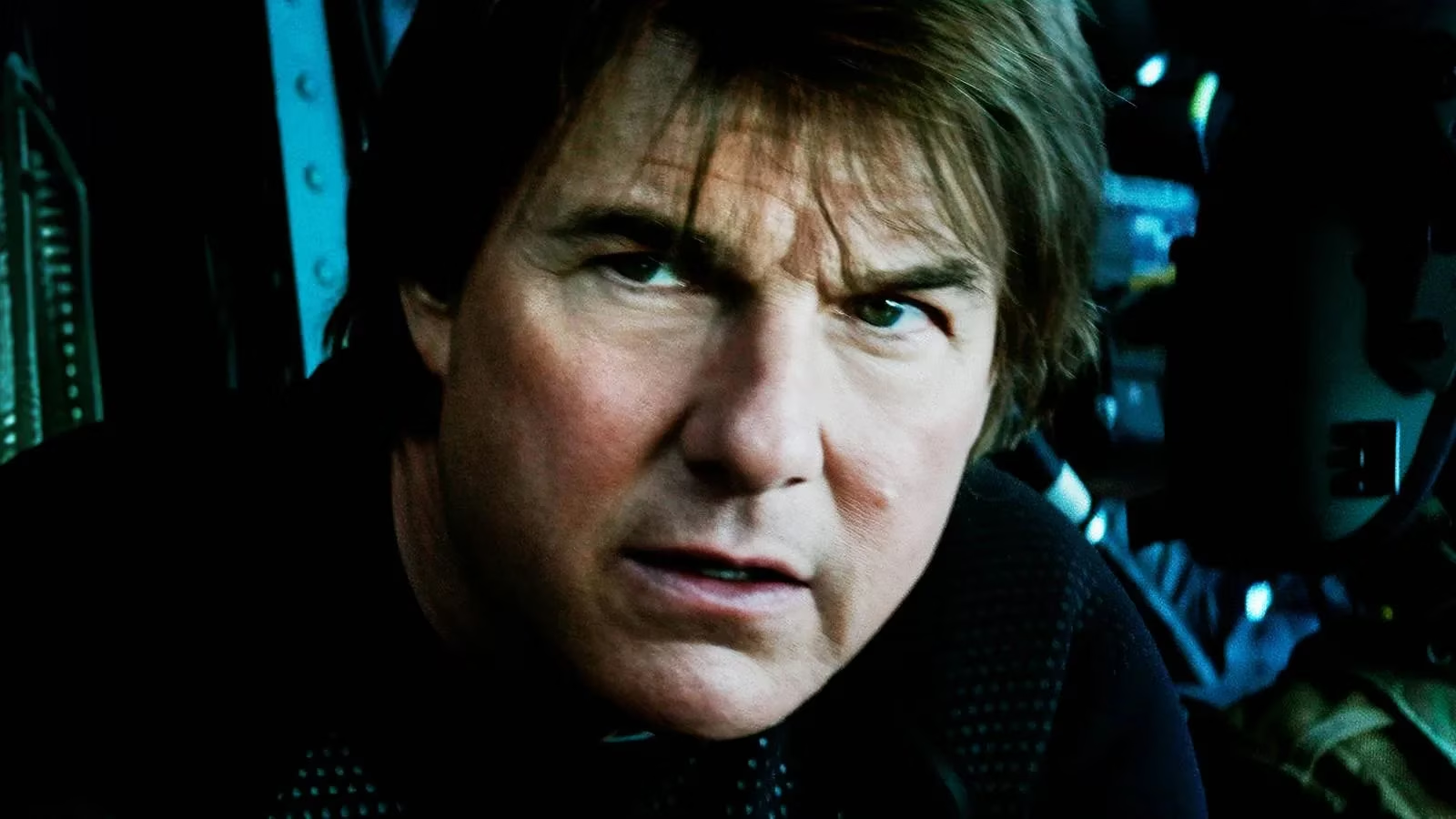
The Ghost of Jim Phelps Still Haunts Ethan Hunt
One of the sharpest callbacks in The Final Reckoning concerns Briggs, an agent who seems to carry a personal grudge against Ethan. The film reveals that Briggs is actually the son of Jim Phelps, the treacherous villain from the original Mission: Impossible. Because Briggs does not believe Ethan’s account of what happened with his father, every interaction between them carries a bitter family legacy. It is a clever way to make the 1996 film matter again without simply repeating it. Instead of resurrecting Phelps, the new movie lets his son question Ethan’s heroism, morality, and memory. That tension enriches the IMF’s internal politics and gives Ethan a rare chance to confront the human cost of his earliest victory.
The first film’s Langley heist also returns in spirit. That sequence, one of the franchise’s greatest stunts, involved Ethan and his team breaking into a CIA site in Virginia to steal the NOC list. To pull it off, they drugged CIA analyst William Donloe so they could access the computer and download the files. It was a tight, tense set piece, and Donloe was only a minor part of it. Yet The Final Reckoning turns him into an important supporting player, proving that even the smallest faces in Ethan’s past can grow into something meaningful.
William Donloe Gets an Unlikely Redemption Arc
After the Langley theft, Donloe was held at least partially responsible for what Ethan did. He was shipped out to Alaska, a distant and undesirable post where he was expected to live out the rest of his days in obscurity. In a surprising move, The Final Reckoning brings him back. Alaska may have been a punishment, but it also becomes the place where Donloe meets the love of his life. More importantly, he becomes an excellent addition to the team, working to defuse the bomb in the film’s climax. 💣
That arc is a perfect example of what makes The Final Reckoning feel special. Donloe is not just an Easter egg. He is a person whose life was derailed by Ethan’s mission, and the new film allows him to become a hero in his own right. It is a redemption story that rewards longtime viewers while still working for anyone who simply enjoys a good spy thriller.
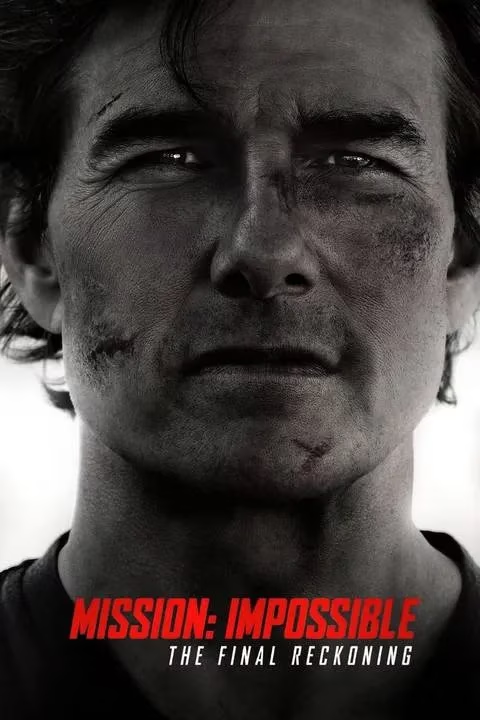
The Rabbit’s Foot Finally Becomes the Entity’s Origin
The biggest narrative bridge in The Final Reckoning connects to Mission: Impossible III. That 2006 film, directed by J.J. Abrams, introduced Owen Davian as one of Ethan’s most fearsome foes and complicated his personal life so thoroughly that a real romantic relationship became nearly impossible. But the film’s most important leftover was the Rabbit’s Foot, a mysterious macguffin that Abrams never fully explained. It carried a biohazard symbol, sparking speculation that it was a doomsday device, a war weapon, or something even worse.
The Final Reckoning finally answers the question. The Rabbit’s Foot is revealed to be the precursor to the AI villain that hangs over both Dead Reckoning and The Final Reckoning. It contains source code which, when used by Denlinger, can evolve and become the villainous Entity. That makes the AI threat feel contemporary and urgent rather than disconnected from franchise history. The Entity itself does not have much screen time, but its presence is frightening because it is the logical endpoint of a weapon Ethan helped recover years ago. 🤖
| Callback | Original Film | New Role in The Final Reckoning |
|---|---|---|
| Jim Phelps | Mission: Impossible | Briggs is his son and distrusts Ethan |
| William Donloe | Mission: Impossible | Returns from Alaska and helps defuse a bomb |
| Rabbit’s Foot | Mission: Impossible III | Contains source code that becomes the Entity |
| Ethan’s personal sacrifice | Mission: Impossible III | Sets up his inability to have a normal romance |
Why the First and Third Films Are Now Essential
The Mission: Impossible franchise has always had two distinct phases. The first three films each had a different director: Brian De Palma, John Woo, and J.J. Abrams brought their own signature styles. Then Brad Bird revitalized the series with Mission: Impossible – Ghost Protocol, which brought in Tom Cruise’s frequent collaborator Christopher McQuarrie as an uncredited scriptwriter. McQuarrie eventually took the reins and found a more consistent tone. The Final Reckoning, however, reaches back before his era and makes those older stories matter again.
That is a bold choice. By tying Briggs to Jim Phelps and the Rabbit’s Foot to the Entity, the film transforms scattered moments into a larger mosaic. Ethan has grown across the series, and seeing similar growth in Donloe, or seeing an old object evolve into a modern nightmare, makes each entry feel more essential. In 2026, The Final Reckoning remains a rewarding rewatch because it does not just close a story; it reframes the beginning. For fans, the first and third Mission: Impossible films are no longer optional. They are required reading for Ethan Hunt’s final reckoning. 🕵️
Recent trends are highlighted by OpenCritic, whose aggregated reviews help frame why long-running franchises thrive on continuity: much like a game series that rewards players for remembering earlier story beats, The Final Reckoning leans on deep callbacks (Jim Phelps’ legacy, Donloe’s fallout, and the Rabbit’s Foot’s true significance) to make returning viewers feel that prior “missions” are essential context rather than optional lore.
Comments