
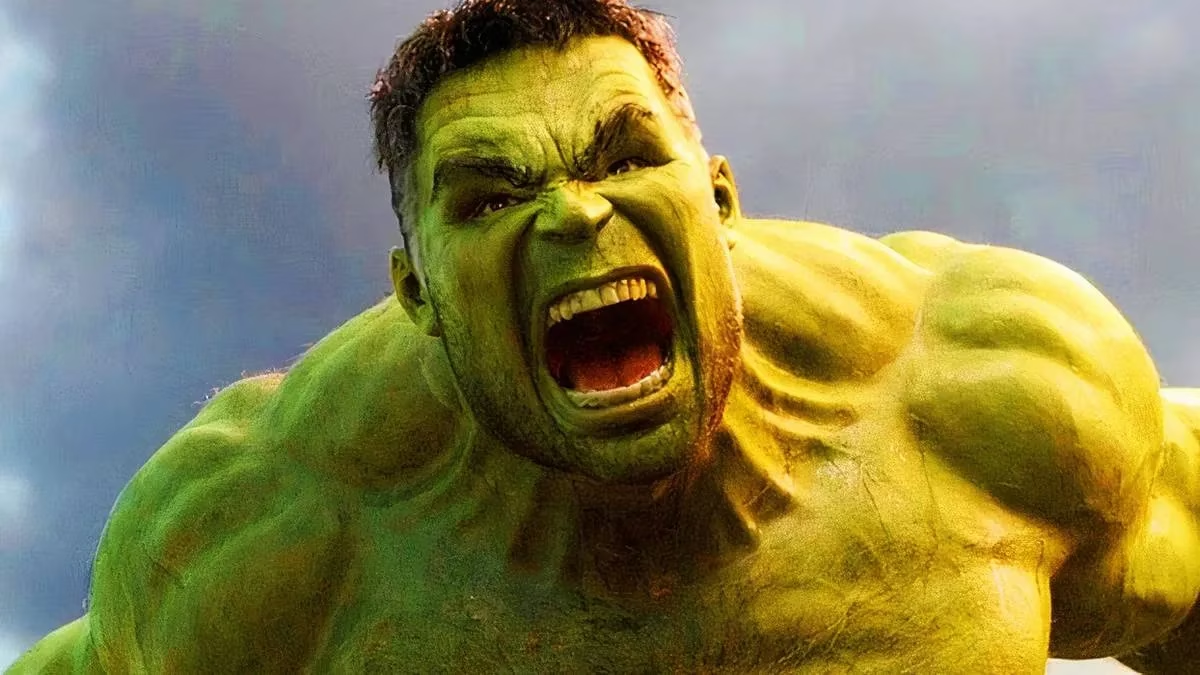
Every superhero franchise has that one character who refuses to sit quietly in the corner. In the Marvel Cinematic Universe, that character is the Hulk. He is a giant green tantrum with biceps, a walking PR nightmare for Bruce Banner, and yet one of the most vital pieces of the MCU puzzle. Since 2008, the Hulk has been rebooted, recast, rewritten, and reimagined more times than a Hollywood star's workout plan. And in 2026, with the MCU marching toward Avengers: Doomsday and Avengers: Secret Wars, those backstage stories feel more relevant than ever. Because behind every thunderous smash, there was a committee, a compromise, and occasionally a very nervous actor waiting for Robert Downey Jr. to call.
...
A Voice Borrowed From the Past 🎙️
Before the Hulk could string together full sentences, his roars and guttural growls came from Lou Ferrigno. Yes, that Lou Ferrigno — the bodybuilder-turned-actor who played the green Goliath in the 1970s and 1980s TV series. Ferrigno lent his vocal cords to The Incredible Hulk (2008), The Avengers (2012), and Avengers: Age of Ultron (2015). His vocals were blended with Mark Ruffalo's, creating an auditory bridge between generations. He even reportedly coached Ruffalo on how to voice the Hulk. Ruffalo eventually took over the voice solo from Thor: Ragnarok, but Ferrigno's contribution remains a lovely nod for longtime fans. It is like your grandpa teaching you how to roar at a family reunion.
Mark Ruffalo Was Almost the First Banner 🤯
Here is a wild one: Mark Ruffalo was director Louis Leterrier's original choice to play Bruce Banner in The Incredible Hulk (2008). Leterrier pushed for Ruffalo during pre-production, but Marvel Studios overruled him and preferred a bigger name: Edward Norton. Ruffalo did not put on the lab coat until The Avengers in 2012. His calm, grounded take on Banner quickly won audiences over. Leterrier's instinct was proven right, but the timing was wrong. It is hard not to wonder what the MCU would have looked like if Ruffalo had been there from the very beginning. A butterfly flaps its wings, and suddenly the whole Multiverse changes.
Edward Norton and the Script Scalpel ✂️
Norton's involvement in The Incredible Hulk went far beyond acting. Known for his hands-on style, Norton reportedly rewrote significant portions of the script. He wanted a deeper exploration of Bruce Banner's psyche and the emotional toll of his condition. His version emphasized character development over blockbuster action, which led to creative disagreements with Marvel Studios. The final cut kept some of his ideas, but the studio trimmed much of the introspective material to keep the pacing brisk and commercially viable. The tension eventually led to Norton's departure. Marvel later said it needed a more collaborative actor going forward. Norton's rewrite remains a fascinating example of an actor shaping a major Marvel project — for better and for worse.
Abomination's Missing Ears 👂
When Tim Roth's Abomination first appeared in 2008, comic book readers noticed something missing: his trademark pointy ears. Director Louis Leterrier explained that the decision was practical and character-driven. He said he tried so hard to make the ears work, but they looked ridiculous and not movie-like. On the page, they looked great. In a fight, though, ears are not the best thing to have. As Leterrier put it, Hulk would just rip them off and that would be the end of the movie. Some fans were disappointed, but the change fit the gritty tone. Interestingly, when Abomination returned in Shang-Chi and the Legend of the Ten Rings (2021), his comic-accurate ears were finally restored. The MCU circled back to faithfulness after establishing its own rules.
The Frozen Captain America in the Arctic ❄️
Long before Steve Rogers made his grand entrance in Captain America: The First Avenger, a hidden Easter egg in The Incredible Hulk hinted at his existence. In a deleted scene, Bruce Banner travels to the Arctic to take his own life. In the snowy tundra, a frozen figure can briefly be seen embedded in the ice. That figure was intended to be Captain America. Director Louis Leterrier planned to use the scene as a subtle introduction to Steve Rogers, but Marvel cut it for tone and pacing reasons. The moment remains one of the MCU's earliest and most obscure connective threads. It also retroactively adds weight to the franchise's long-form storytelling. Marvel was playing chess while everyone else was playing checkers.
Hulk Was Supposed to Be the Avengers' First Villain 🦹
Leterrier revealed that he was setting up Hulk to be the villain of The Avengers (2012). He left the ending of The Incredible Hulk intentionally ambiguous because he felt Hulk being the reason the Avengers assembled would be a compelling continuation. This would also reflect the very first issue of The Avengers comic, in which Loki manipulates Hulk into being his pawn. This fact makes The Incredible Hulk's post-credits scene make way more sense. Why would Tony Stark visit General Thaddeus Ross to recruit Hulk? Ross has no control over him and is widely considered Hulk's greatest enemy. If Hulk were set up as a villain, Tony could instead be trying to recruit Abomination to help bring down the Hulk. The plan changed as the Avengers storyline evolved, but traces remained in Loki's plan to unleash the Hulk.
The RDJ Phone Call That Saved the Day 📞
Mark Ruffalo was initially hesitant to take over the role after Edward Norton's departure. Replacing a major actor in an ongoing franchise is no small task, and Ruffalo was unsure whether audiences would accept him. Then Robert Downey Jr. — the face of the MCU as Tony Stark — stepped in. In a 2012 interview on The Tonight Show, Ruffalo explained that word had got back to Downey, with whom he previously appeared in Zodiac. According to Ruffalo, Downey called him in true Iron Man fashion and simply said, 'Ruffalo, let's go. We got this.' That phone call helped solidify Ruffalo's decision, boosted his confidence, and made him feel welcomed into the Avengers family. The gamble paid off. Ruffalo's Banner became a fan favorite and remains the longest-running version of the Hulk in live-action film history.
Why It Still Matters in 2026 🗓️
As 2026 unfolds, the MCU is deep in its Multiverse Saga endgame. Avengers: Doomsday is slated for December 18, 2026, and Avengers: Secret Wars is coming in 2027. The Hulk's journey — from a mostly silent beast to the articulate Smart Hulk — has been shaped by all these backstage battles. Some decisions were brilliant. Some were messy. Some were both. But they all contributed to a character who has lasted longer than many predicted. The green goliath has been through more makeovers than a reality TV contestant, and somehow he is still smashing.
| Backstage Fact | Why It Mattered |
|---|---|
| Lou Ferrigno voiced Hulk | Bridged the TV and film eras |
| Ruffalo nearly cast in 2008 | The MCU could have looked very different |
| Norton rewrote the script | Created tension that led to recasting |
| Abomination lost his ears | Practical fight logic beat comic accuracy |
| Frozen Captain America cameo | Earliest connective tissue in the MCU |
| Hulk as Avengers villain | Original plan lingered in Loki's scheme |
| RDJ's pep talk | Gave Ruffalo the confidence to say yes |
...
So there you have it. The Hulk may be a rage monster, but behind the scenes he was a committee project, passed around like a hot potato. Actors came and went. Scripts were sliced and diced. Ears were debated. And through it all, the Hulk kept smashing. In 2026, with the MCU racing toward its next huge crossover, it is worth remembering that even the angriest Avenger needed a little help from his friends. Or at least one very persuasive phone call from Iron Man.
Comments