
The Marvel Cinematic Universe has spent nearly two decades carefully assembling a clockwork cosmogony of heroes, but its greatest villain architect may finally be taking shape through the most unexpected of apprenticeships. With Avengers: Doomsday now slated for a December 2026 release, the road to Victor Von Doom’s grand entrance is undeniably narrower than initially planned. Yet the MCU appears to be employing a master stroke of forward-engineering—one that turned an unassuming 2025 Disney+ series into a crucial laboratory for synthesizing two seemingly incompatible forces: science and sorcery.
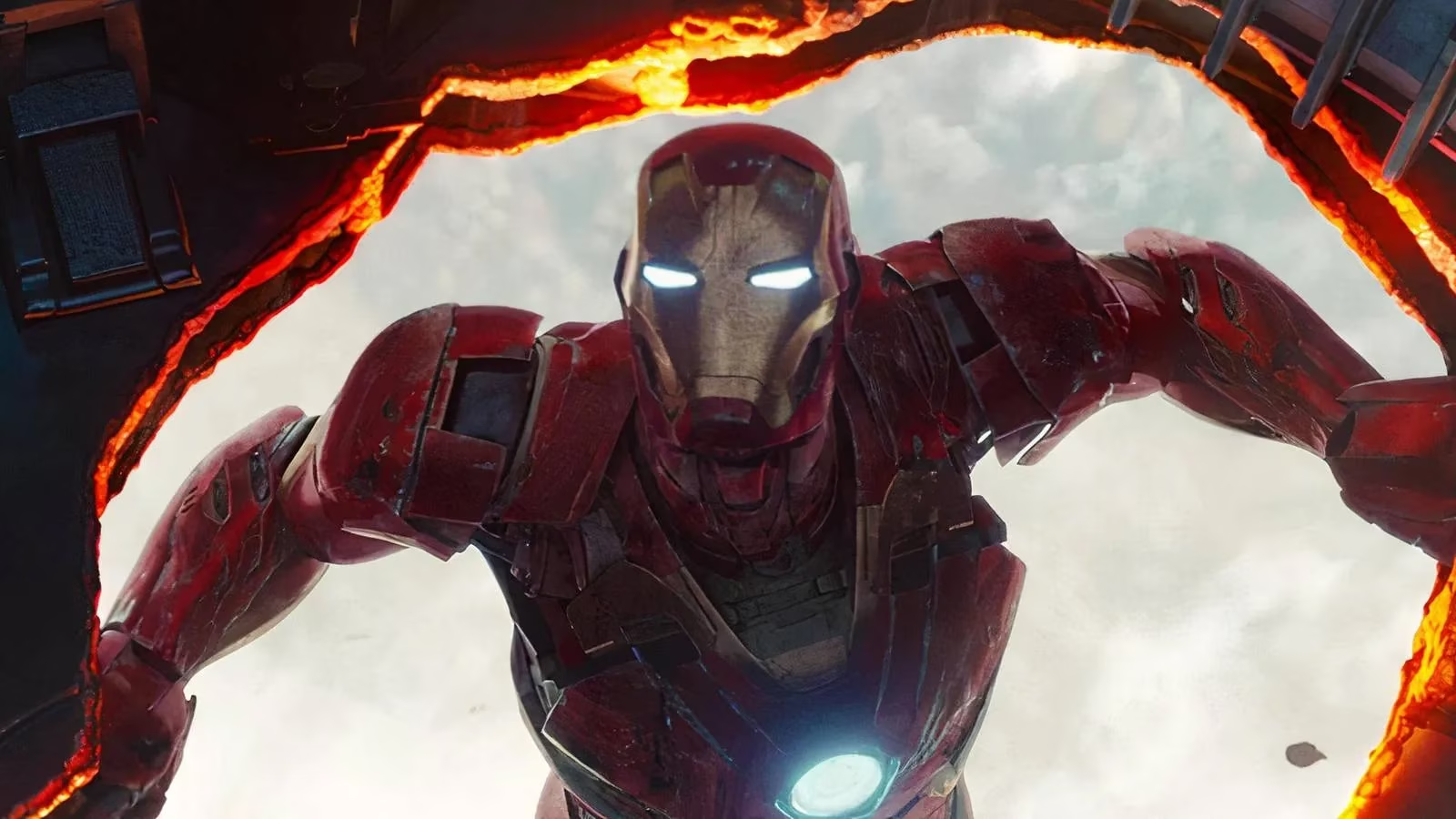
When Ironheart premiered, many viewers focused on Riri Williams’ emotional arc and her decision whether to ally with magic-wielder The Hood. Buried beneath that surface conflict, however, was a quiet tectonic shift in how the MCU handles one of its foundational dichotomies. The series explicitly showed Riri weaving mystical energies into her Ironheart armor, creating a hybrid engine that ran on both equations and incantations. This wasn't merely a cool visual—it was a deliberate load-bearing beam lowered into the franchise's narrative foundation. For years, the MCU had maintained a polite fence between the laboratory and the sanctum. Tony Stark’s “we’re not wizards” quip in Age of Ultron underscored a philosophical segregation that kept the universe feeling grounded. Now, Ironheart took a crowbar to that wall.
The reason this matters for Doctor Doom goes beyond mere thematic resonance. In Marvel lore, Victor Von Doom is the undisputed master of straddling two worlds that most characters treat as mutually exclusive. He wields sorcery potent enough to contend with Doctor Strange while simultaneously engineering technology rivaling Reed Richards. His armor isn’t simply a metal shell; it’s a living grimoire of arcane alloys, its circuits etched with runes and its weapons calibrated by both quantum mechanics and dark incantations. Introducing such a figure cold into the MCU would risk audience whiplash—a villain who feels like a cheat code rather than a credible threat. Ironheart solves this problem by making the fusion of magic and science a gradual, observable process, akin to watching someone learn to breathe underwater. By the time Doom arrives, the MCU’s audience will already understand the grammar of this new power language.
Consider the MCU’s historical anxiety about “overpowered” magic. Doctor Strange’s journey was painstakingly tiered: from basic sparkler spells to the Mirror Dimension to the Time Stone’s manipulation. Similarly, Scarlet Witch’s reality-warping evolved over half a dozen appearances. The franchise has always treated magic like a fragile teacup, knowing that one careless escalation could shatter its internal logic. Now, Ironheart brings that same caution to the alchemy of magic and metal. Riri’s early experiments are clumsy, dangerous, and often backfire—a necessary teething phase for a concept that will one day define the MCU’s deadliest monarch. It’s as if the MCU is planting a sapling of a tree whose fruit Doom will eventually feast upon.
🔮 ⚙️ Key Character Parallels:
| Character | Science | Magic | Combined Application |
|---|---|---|---|
| Riri Williams / Ironheart | Genius-level engineering, powered armor | Borrowed from The Hood, nascent | Suit enhanced by mystical energy; early-stage fusion |
| Victor Von Doom | Master of robotics, cybernetics, quantum physics | Skilled sorcerer, trained by Tibetan monks (comics) | Armor and arsenal seamlessly integrate both; no division |
This table isn't just comparative—it’s a timeline. Riri’s current position sits at the shallow end of a pool that Doom has been swimming in for decades. By letting her dog-paddle there first, the MCU primes its mythology to accept the Latverian dictator’s terrifying fluency without needing lengthy exposition in Doomsday or Secret Wars.
There’s a secondary, more poignant benefit: it rescues Riri Williams from the shadow of Iron Man’s absence. The tragic death of Tony Stark in Avengers: Endgame severed the mentor-protege bond that comics fans anticipated. Without that generational tether, Ironheart risked becoming a storyline orphan. Her pioneering work in mystical-technology fusion, however, positions her as an inadvertent prophet of Doom’s methodology. Should Doom ever recognize this parallel, a compelling rivalry could ignite—one built on respect, rivalry, and the unsettling notion that Riri may have glimpsed a path that leads directly to a throne.
That dramatic potential is the real payload beneath Ironheart’s surface. The MCU has often struggled to make younger legacy characters feel organically meaningful beyond nostalgia. Here, Riri isn’t just filling a suit; she’s unknowingly drafting the operating manual for a future tyrant. The metaphorical architecture is satisfying: she builds the scaffolding while Doom, unseen, is already forging the castle that will sit upon it.
As Avengers: Doomsday looms, the MCU’s patience is beginning to look like precision. The 2025 release, seemingly a modest character study, now reads like a seismograph needle quietly trembling before an earthquake. Victor Von Doom’s arrival won’t feel like a parachuted-in villain’s monologue about his dual expertise; it will feel like the inevitable bloom of a seed the franchise planted years earlier. And in an interconnected universe where the best storytelling often hides in plain sight, Ironheart may be remembered as the moment the MCU lit its own Doom-shaped beacon—not with a thunderclap, but with the soft hum of a hybrid engine coming to life.
Comments